How Does It Work?
Whole-home water, reengineered for municipal and well-water supplies. CleanWater systems combine mechanical capture, nanoscale active filtration and a final carbon polish while maintaining high flow and avoiding a wastewater stream.
The facts
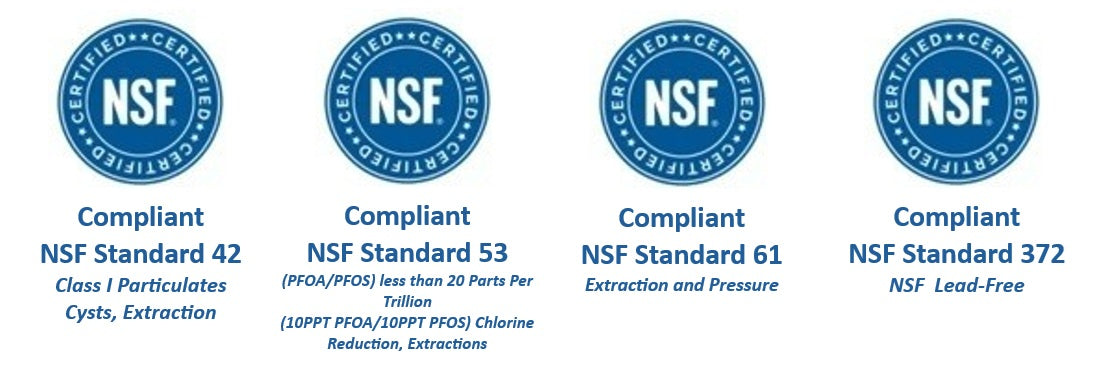
- Third-party tested and in compliance with NSF 42, 53, 61, 372.
- Targets bacteria, viruses, cysts, spores and other pathogens
- Reduces heavy metals, PFAS/PFOA/PFOS, pesticides and pharmaceuticals
- Anti-scale filter to treat hard water
- No water softener needed · no heavy bags of salt · no salinized wastewater
- Reduces scale buildup on faucets, cookware, appliances; leave good minerals in water
- Particulate reduction down to 20 nm
Stage 1 — Mechanical capture and conditioning
A multi-faceted first stage removes sediment and larger particles while conditioning incoming water to reduce calcium-carbonate scale.
Stage 2 — Nanoscale active filtration
High-surface-area media targets bacteria, viruses, cysts, spores, pesticides, pharmaceuticals, PFAS/PFOA/PFOS and heavy metals without the pressure loss and wastewater associated with reverse osmosis.
Stage 3 — Final carbon polish
Stage 3 is the final polishing of PFOA/PFOS, lead, chlorine, pesticides, and other contaminants with a high-capacity carbon filter. This improves taste and smell of water. This carbon will outperform similar carbons due to the purity of water at this step of the process.
For larger, closed-loop and wastewater applications, engineering can customize the same approach to reduce discharge, operating costs and environmental impact.